
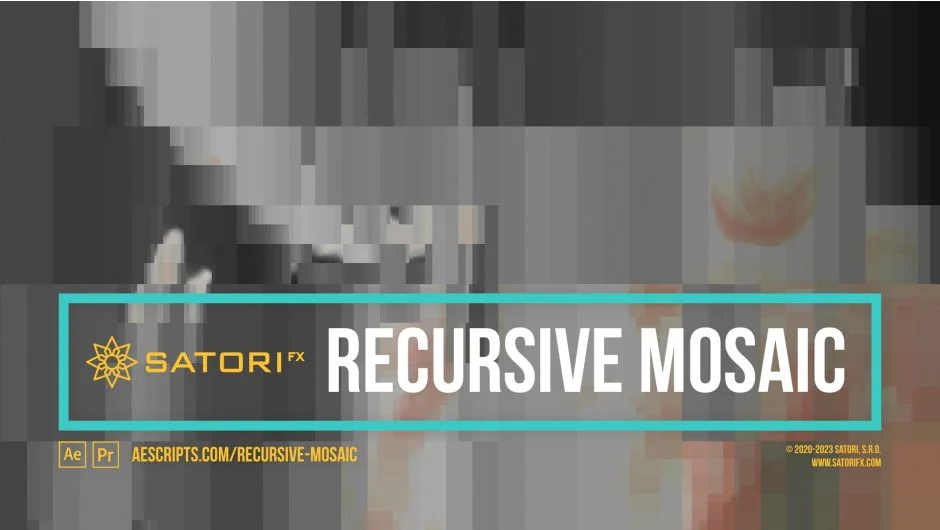
What It Does
Recursive Mosaic applies a pixelation effect by dividing an image into a grid, then recursively subdividing those grid cells based on image detail. Unlike a standard mosaic filter that applies uniform block sizes, this approach can preserve edge detail in complex areas while flattening simpler regions into large blocks. It also works well for simulating JPEG compression artifacts.
Available for both After Effects and Premiere Pro (CS6 through 2024), with support for Windows, macOS Intel, and Apple Silicon.
Key Features
Mosaic Intensity. A single slider that controls how blocky the result looks. At 0, the original image is preserved. At 1, only the largest blocks defined by the grid are shown. Animating this value creates a de-pixelation or reveal effect.
Grid Width and Height. Set the initial number of horizontal and vertical subdivisions before recursion begins. This defines the coarsest block size in the output.
Maximum Iterations. Controls the recursion depth. Low values keep everything in large blocks; higher values allow finer sub-blocks to emerge in detail-rich areas.
Intensity Source. Point the effect at a separate layer or track to drive the mosaic threshold externally. Useful for masking pixelation to specific regions or animating it with a grayscale map.
Channels. Choose whether the effect processes luminosity, full RGB (channels treated separately), or individual color channels including alpha. Separating RGB channels combined with Curve Phase Split can produce colorizing glitch effects.
Curve controls (added in v1.2.0). The Curve, Curve Phase, and Curve Smoothness parameters give precise control over how block complexity maps to the mosaic threshold. A built-in Curve Graph visualizes the mapping in real time (requires CC2015 or later).
Multi-frame rendering. Supported as of v1.2.0, so it works with Premiere Pro’s and After Effects’ parallel rendering pipelines without slowdown.
Who It’s For
Editors and motion designers who want pixelation that does more than a basic mosaic. The recursive approach makes it useful for data-moshing aesthetics, glitch art, JPEG artifact simulation, and animated reveal effects where pixel blocks dissolve into image detail. The Intensity Source parameter makes it practical for compositing workflows where the pixelation needs to respond to another element in the scene.
Pricing
Recursive Mosaic is a one-time purchase at $27.99 for a single-user license. A free trial is available from aescripts.com. Floating server and render-only licenses are also offered at different price points.